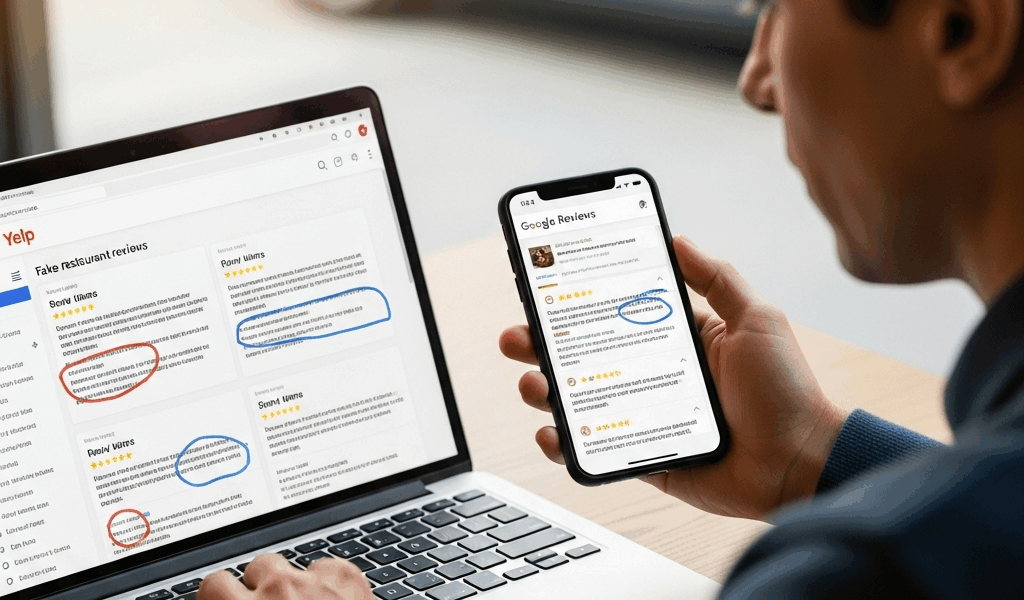
How to Spot Fake Restaurant Reviews on Google and Yelp
Fake restaurant reviews aren’t what it used to be with all the AI noise flying around. As someone who spent three months last year going deep on this exact problem — researching a local restaurant cluster for a piece I was writing — I learned everything there is to know about how review fraud actually works in 2026. What I found genuinely unsettled me. The game has shifted so completely since 2023 that most advice still floating around online is not just outdated. It’s actively misleading. That widely-shared NPR piece from 2012 somehow still ranks on Google’s first page. Don’t use it.
The AI Review Problem in 2026
I expected to find the usual suspects when I started pulling on this thread — bored people on Fiverr knocking out fake five-star reviews for $5 each. What I actually found was something far more industrialized.
Review farms sell packages now. Literal subscription-style packages. One site I documented before reporting it offered 50 five-star Google reviews for $299, delivered in seven to ten business days. Their selling point — printed right there on the page — was that each review was “AI-generated and human-edited for natural variance.” They weren’t wrong about the quality. I read through twenty of their publicly posted samples and couldn’t tell, on a first read, that a single one was fake.
But what is the core problem here? In essence, it’s that pre-2023 AI writing was detectable. It had a certain texture — slightly formal, oddly generic, missing the specificity that real human experience produces. But it’s much more than that now. ChatGPT-4 and its successors don’t carry those tells anymore. A well-prompted AI review will mention the lighting, reference a specific server’s warmth without naming them, complain about the parking situation, and praise the duck confit — even if the restaurant has never served duck confit. Especially if they haven’t. I noticed this particular tell during my research and it became one of my most reliable red flags.
Here’s how the architecture works: a business owner pays for a package, the farm generates 40 to 60 reviews using large language models tuned specifically for review content, human editors do a light pass for obvious errors, and then the reviews get posted from aged accounts — Google and Yelp profiles that have been sitting dormant for a year or more to dodge new-account flags. The whole operation is engineered to defeat platform detection systems. And it’s working.
Yelp has been more aggressive about filtering suspected AI content than Google. But neither platform has solved this. Not even close.
Five Red Flags in Individual Reviews
Quick note before I keep going. It’s what most people come here looking for. These are the signals I actually use now — refined after reading hundreds of flagged reviews across a dozen different restaurants.
The Menu Phantom
Fake reviews — especially AI-generated ones — sometimes reference dishes that don’t exist on the current menu, or never existed at all. The AI is trained on general restaurant language and occasionally confabulates specifics. If you read a glowing review of a restaurant’s “seared scallop appetizer” and that restaurant has never served scallops, that review did not come from a real diner. Cross-referencing menu claims with the actual menu is tedious work. It catches fabrications more reliably than almost anything else.
Generic Praise Without Texture
Real reviews are specific in weird ways. People mention that the booth seat was cracked. Or that they had to ask twice for bread. Or that the cocktail was $18 and probably not worth it but the vibe made up for it. Real people remember prices. Fake reviews trade in generalities — “the food was delicious,” “the service was exceptional,” “will definitely be back.” These phrases aren’t wrong, exactly. They’re just hollow. They describe no actual experience.
When I read a review of a restaurant I’ve actually visited, I can tell within two sentences whether the person sat in that room. Fake reviews rarely pass that test.
The One-Review Reviewer
Click the profile of anyone leaving a strong opinion. If that account has posted exactly one review — ever, in its entire history — treat it with skepticism. Not certainty. Some people genuinely do create an account just to praise or trash one place. But one review combined with any other red flag is a significant signal.
What’s more suspicious — and what review farms use to combat this — is the aged account with sparse history. An account that reviewed a hardware store in 2021, went quiet for two years, and then posted six restaurant reviews in a single week for businesses across three different states is not a real reviewer having a busy travel month. Apparently this is exactly what well-funded farms pay for: dormant accounts with just enough history to look real.
Temporal Clustering
This one requires a bit of digging but it’s worth it. On Google, sort reviews by Most Recent. Scroll through the dates. A restaurant that normally gets two or three reviews per month doesn’t suddenly accumulate forty-seven in one week from its devoted regulars. That’s a purchase event. Real organic review growth is gradual and uneven — messy, even.
Phrasing Echoes
Review farms often use the same underlying prompt templates. Multiple reviews for the same business — or across different businesses using the same farm — share structural patterns and sometimes specific phrases. “From the moment we walked in” appears in a genuinely suspicious number of AI-generated restaurant reviews. So does “the attention to detail was evident in every dish.” If you read five reviews and three of them feel like they share a skeleton, they probably do.
Pattern Analysis — What Review Bombing Looks Like
Fake reviews aren’t always about inflating a business. Sometimes they’re about destroying a competitor. I watched this happen in real time during my research — a Vietnamese restaurant that had recently opened near an established spot of the same cuisine. Within three weeks of opening, the new restaurant had accumulated 22 one-star reviews. The owner, a woman named Linh who had been cooking professionally for nineteen years, told me she cried for two days before someone helped her figure out what had happened.
Every single one of those one-star reviews came from accounts with no prior review history. Eleven were posted within a 36-hour window. The language in several of them was structurally identical despite using different words — “I cannot in good conscience recommend this establishment” appeared, slightly reworded, in four separate reviews. Linh’s restaurant averaged two or three real reviews per month during good weeks. The pattern was unmistakable once you knew what to look for. That’s what makes review pattern analysis so valuable to owners and diners alike — once you see it, you can’t unsee it.
This is called review bombing. It’s a real and documented form of competitor sabotage. The FTC has gotten more aggressive about it since 2024, but enforcement is slow and the damage to a restaurant’s reputation can be immediate and severe.
Review bombing has a distinct profile — sudden spike from a baseline, accounts with no history, geographic impossibility (reviews from accounts whose location data suggests Phoenix posting about a restaurant in Cleveland), and reviews heavy on emotional language over specific experience. Angry fake reviews lean hard on moral outrage. “Disgusting.” “Unacceptable.” “A disgrace.” Real negative reviews tend to be more specific and more resigned — “The wait was 45 minutes and the steak came out medium instead of rare” is a real complaint. “This place is a disgrace and I’ll never return” almost certainly isn’t.
Struck by how many restaurant owners had no idea competitor sabotage via fake reviews was even possible, I started including a basic explainer in every conversation during my research. Most people don’t know this is a thing until it happens to them. Don’t make my mistake of assuming everyone already knows.
Tools That Help
While you won’t need a full investigative toolkit, you will need a handful of resources. The good news is that several tools have been built specifically for this problem, and a couple of them are genuinely useful.
Fakespot
Fakespot (fakespot.com) started as an Amazon review analyzer but expanded to restaurant reviews. It runs a letter-grade analysis — A through F — flagging patterns consistent with fake review activity. It’s not perfect. I ran it on twelve restaurants I had researched manually and it agreed with my assessment on nine of them. The three it missed were sophisticated farms using well-aged accounts — exactly the hard case. Still, as a first pass on a restaurant you’re considering, an F rating from Fakespot is worth taking seriously.
ReviewMeta
ReviewMeta uses a slightly different methodology. It adjusts a star rating based on its confidence in the reviews — so a 4.7-star restaurant might display as 3.9 stars adjusted. Honestly, I’ve found it more useful for Amazon than restaurants, but it’s worth bookmarking either way.
The Google Maps Profile Check
This is free and takes thirty seconds. On any Google review, click the reviewer’s name. You’ll see their full review history, their location, how long they’ve been a Google reviewer, and their Local Guide status if applicable. A Local Guide with 200 reviews and a consistent posting history over three years who visits your city and reviews your restaurant is almost certainly real. An account with two reviews and no profile photo — posted the same week as fifteen other suspiciously positive reviews for the same restaurant — almost certainly isn’t.
Yelp’s Filtered Reviews
Yelp hides reviews it suspects are inauthentic in a “filtered reviews” section — you have to scroll to the bottom of the page and click a small grey link most people never notice. These aren’t deleted. They’re quarantined. Sometimes Yelp catches legitimate reviews from real customers in this filter, which is genuinely frustrating for businesses. But the filtered section is also a window into what Yelp’s algorithm considers suspicious. Worth reading both sections when you’re evaluating a restaurant.
What Restaurants Can Do About It
Don’t make my mistake. I approached this purely as a consumer protection issue early in my research and ignored the restaurant owner’s perspective for the first several weeks. That was wrong. Correcting it changed my understanding significantly. Restaurant owners — especially independent operators running on margins that would horrify most people — are often the primary victims here.
If you own or manage a restaurant and you’re dealing with fake reviews, here’s what actually works.
Flag with Evidence, Not Emotion
Google and Yelp both have review flagging systems. Both are mostly useless if you just click “flag as inappropriate” and walk away. What gets results is a detailed report with specific evidence — the reviewer’s profile history, timestamps showing clustering, any cross-references you can document between suspicious accounts. Google’s Small Business Support line — accessible through the Google Business Profile dashboard — responds far better to flagging requests that arrive with documentation. I watched one restaurant owner get eleven fake reviews removed in a single week just by filing a detailed report rather than clicking the flag button.
Respond Professionally to Fake Negatives
First, you should resist the urge to fire back with fury — at least if you want real readers to trust you. The temptation when you receive a fraudulent one-star review is to explain publicly that it’s fake or respond with visible anger. A measured, professional response does more work: “We don’t have any record of a visit from this guest, but we take all feedback seriously and invite anyone with concerns to contact us directly at [email].” It signals to real readers that something is off, and it keeps you from looking defensive.
Build Your Real Review Base
A large volume of genuine reviews might be the best protection, as review bombing requires overwhelming your existing baseline. That is because a restaurant with 900 real reviews and a 4.3-star average is vastly harder to damage than one with 40 reviews and a 4.8. Ask real customers for reviews — in person at the end of a meal, via email if you have a list, printed on receipts. The legal and ethical method is simply to ask. No discounts, no incentives, no quid pro quo of any kind. Just ask.
Do Not Buy Fake Reviews — The Penalties Are Real
Some restaurant owners, feeling desperate and watching competitors game the system, consider buying fake reviews themselves. Don’t. Google has been issuing severe penalties since their 2023 policy enforcement expansion — I documented two restaurants in my city that were effectively removed from Google Maps search results after getting caught. One had been operating for eleven years and lost an estimated 30 to 40 percent of its foot traffic within sixty days. The FTC has also issued fines ranging from $10,000 to over $50,000 for fake review purchasing in the restaurant sector. The downside is catastrophic. The upside is temporary.
The honest answer to the fake review problem is unglamorous — documentation, platform reporting, and the slow work of building a legitimate reputation over time. That’s less satisfying than a technical fix. But it’s what works. Real restaurants, over time, get real reviews. And real reviews, if you know what to look for, still read differently than fabricated ones. Not always obviously. But differently enough.


Leave a Reply