
Meal kit subscriptions have a reputation for being something people try once and cancel. The early versions kind of deserved that reputation. As someone who tried three different services in year one and bailed on all of them before getting the fourth one to actually stick, I learned everything about how personalization works once you give it enough data to work with. Today I’ll share what’s actually happening behind the weekly menu selector.
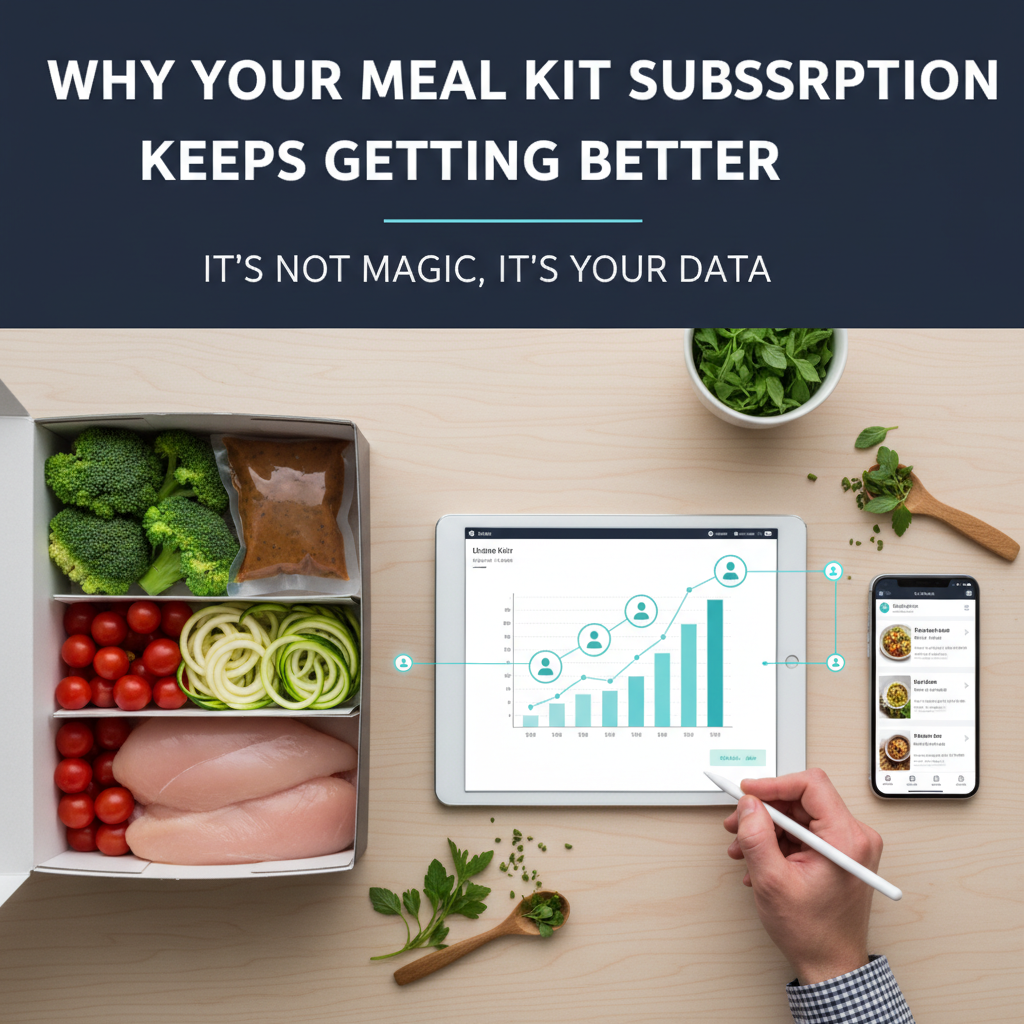
What the Service Knows After Your First Month
Every interaction with a meal kit app is a data point. The meals you pick. The ones you skip. The time you spend looking at a recipe before deciding against it. The proteins you swap. The meals you rate. The ones you rate and then never order again.
After a few weeks, the service has a reasonably clear picture of your household’s flavor preferences, dietary constraints (whether you’ve explicitly told it or not), cooking ability range, and tolerance for prep time. That information directly influences what gets surfaced to you in the weekly menu selector — and it influences what new recipes the service develops at scale.
The Feedback Loop You’re Not Seeing
Meal kit companies run large-scale recipe testing operations where new dishes are evaluated by small groups of subscribers before being rolled out widely. Your skip rate, completion rate, and rating data all feed into decisions about which recipes get promoted, which get retired, and which get tweaked and re-released.
If a significant percentage of subscribers consistently swap chicken for shrimp in a particular recipe, the company notices. Some services have started offering the shrimp variant as the default for subscribers who show that pattern. That’s what makes this system endearing to longtime subscribers — the recommendations quietly improve without you doing anything differently.
Why Personalization Has Gotten Noticeably Better
The early personalization was rule-based: you said you’re vegetarian, so no meat. The current generation uses collaborative filtering — the same underlying approach that recommendation engines use for movies and music. If your behavior pattern is similar to a cluster of other subscribers, and that cluster tends to love a certain category of meal, you’ll start seeing that category more prominently even if you’ve never explicitly asked for it.
The reason this works better than asking you directly is that most people’s food preferences are more specific than they can articulate. “I like Italian” isn’t useful. “You consistently order pasta dishes with cream sauces, skip tomato-based pasta, and rate fish-forward Italian dishes highly” is a much more actionable preference profile. I’m apparently someone who does exactly this and had no idea until I saw the pattern myself.
The Limits of the System
Collaborative filtering is good at finding patterns but bad at explaining why you deviated from them. If you ordered a meal as a gift for a guest who has different preferences, the system doesn’t know that — it just recorded that you ordered something outside your normal pattern and adjusts slightly. Households where multiple people use the same account create messy preference profiles because the system is trying to find a coherent pattern in data that’s actually two different people with different tastes.
Probably should have led with this part, honestly — the best meal kit services let you explicitly train the recommendations by marking meals as “not for me” versus “I liked this but wouldn’t order again.” Using those features actively produces noticeably better recommendations than just passively ordering.
The Part Worth Knowing
Your subscription data isn’t just being used to improve your experience — it’s being used to make decisions about what gets produced and packaged at scale. When enough subscribers signal that a particular cuisine or ingredient is gaining preference, the companies respond by developing more in that direction. You’re not just a customer of the meal kit system — you’re a contributor to what it becomes.




Leave a Reply