Ghost Kitchens on DoorDash — How to Tell If a Restaurant Is Real
Ghost kitchen DoorDash searches have turned into an absolute tangle with all the conflicting information flying around — and honestly, I think that’s because people are finally noticing something feels wrong. You order from a place called “Neighborhood Wings Co.” The food shows up in a plain white bag. Sticker label. No logo. You look up the address out of curiosity and it’s a strip mall with a tax prep office and a nail salon. No restaurant. Never was one. That’s the ghost kitchen economy, and nobody bothered to mention it exists.
As someone who spent several months cross-referencing delivery app listings like a person with too much free time and a grudge, I learned everything there is to know about how these operations hide in plain sight. Checking addresses on Google Maps. Reading one-star reviews from confused customers. Tracking which brand names share phone numbers. Tedious work, honestly. But what I found was a delivery landscape where a significant chunk of the “restaurants” you’re ordering from aren’t restaurants in any traditional sense — and the apps have essentially zero incentive to tell you that.
This guide is for the person on the other side of that transaction. Not operators launching virtual brands. For you — the one who just wants to know whether the taco place you’re eyeing actually exists somewhere on this earth.
What a Ghost Kitchen Actually Is
The term gets thrown around loosely. So — what is a ghost kitchen? In essence, it’s a food preparation facility with no dining room, no storefront, no walk-up window. But it’s much more than that. It’s an entire parallel restaurant economy running underneath the one you thought you understood.
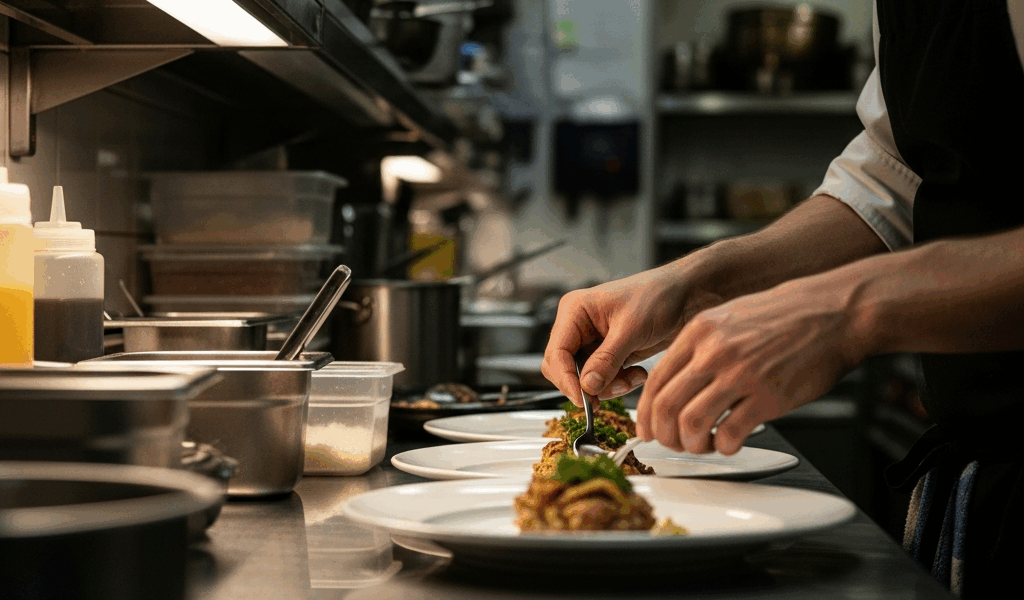
Some ghost kitchens operate out of shared commercial spaces — rented cooking real estate where multiple brands run simultaneously out of the same building. Companies like CloudKitchens, backed by Uber’s Travis Kalanick, built their entire business model around exactly this. One facility might house fifteen different “restaurants,” all sharing the same loading dock, the same prep tables, sometimes the same cooks making food for completely different brand names in the same shift.
Others are run by existing restaurants that launch a secondary brand on the side. Your neighborhood pizza place might also be “Downtown Calzone Factory” on DoorDash. Same oven. Same dough. Different logo. That’s technically a ghost kitchen too — because the secondary brand is a fiction, even if a real kitchen is behind it.
Ghost kitchens are not inherently bad. Want to be clear about that upfront, because this isn’t a takedown piece. Some of the most consistent delivery food I’ve eaten came out of ghost kitchen operations. The food can be genuinely excellent. The problem isn’t the kitchen model — it’s the transparency gap. Consumers who think they’re ordering from an established local restaurant deserve to know what they’re actually getting. That’s the whole issue, full stop.
How to Spot One on DoorDash
Let me back up — this is what matters. It’s what most people actually came here for. Here are the specific signals worth looking for.
The Address Check
Copy the restaurant’s address from DoorDash and paste it into Google Maps. Do this before every order if you actually care about this. What you’re looking for: does a restaurant show up there? Sometimes Maps shows a warehouse. An office building. Literally nothing food-related. Sometimes you’ll see “Kitchen United” or “Reef Kitchens” — both commercial ghost kitchen operators. That’s your answer right there, no further investigation needed.
I once ordered from a place called “The Crispy Bird” — fried chicken, decent reviews, $13.99 for a two-piece with fries. The address resolved to a shopping center anchored by a Supercuts and a mattress store. No food business of any kind. The food was fine, for the record. But I had no idea what I was actually ordering from, and that bothers me more than it probably should.
Multiple Brands, One Address
Search DoorDash for the address you found. Four different restaurant brands listing the same one? Ghost kitchen hub. I’ve found locations in Chicago and Los Angeles where a single address hosts upward of ten active DoorDash listings simultaneously — ten different “restaurants,” one building, one kitchen operation running all of them.
Not illegal. But worth knowing before you hit order.
The Brand Name Test
Ghost kitchen brands follow naming patterns that real restaurants typically don’t. Hyper-descriptive. Slightly generic. “Grilled Cheese Society.” “The Wing Experience.” “Burger Lab.” “Elevated Smash.” These names are optimized for app search results, not for identity — they tell you what the product is, nothing about where it comes from or who made it. A real restaurant usually has a name that tells you something about the owner, the neighborhood, the history. Not just the food category.
That’s not a perfect rule — some brick-and-mortar spots have generic names. But combined with the other signals, it earns its place on the checklist.
No Photos of an Actual Space
Real restaurants have photos of their space. Tables, exterior shots, the counter, signage, the corner booth that’s always a little sticky. Ghost kitchen listings almost exclusively show food photography — professional menu shots with no sense of physical place whatsoever. Scroll through the photo gallery. If there’s not a single image showing you where the food is made, that’s worth flagging.
Reviews That Mention Confusion
One-star reviews are a gold mine for ghost kitchen identification. Look for mentions of “wrong name on bag,” “bag said different restaurant,” “packaging from a completely different place,” or “I couldn’t find this restaurant anywhere.” These show up constantly on ghost kitchen listings — real diners noticing that the bag said “Rosati’s Pizza” when they ordered from “Chicago Style Kitchen.” That’s a virtual brand running out of an existing restaurant’s kitchen, hiding in plain sight in the review section.
The Big Brands Running Ghost Kitchens
This is the part that surprises people most. Some of the biggest names in the restaurant industry have launched virtual brands — ghost kitchen offshoots running out of their existing locations. You’ve probably ordered from one without realizing it.
Applebee’s — Cosmic Wings
Applebee’s launched Cosmic Wings as a delivery-only brand back in 2021. Cosmic Wings doesn’t exist as a restaurant you can walk into — there’s no door to open, no host stand, no parking lot. The wings are made in Applebee’s kitchens, by Applebee’s staff, on Applebee’s equipment. The brand was designed specifically to look like a standalone concept on delivery apps. Ordered Cosmic Wings thinking it was an independent wing shop? You ordered Applebee’s wings. Don’t make my mistake of being the last to figure that out.
Chuck E. Cheese — Pasqually’s Pizza and Wings
This one made national news when a food blogger connected the dots. Pasqually’s Pizza and Wings appeared on delivery apps as a seemingly independent pizza concept — apparently named after some Italian pizza guy. The address? Chuck E. Cheese locations. Same pizza, same kitchen, different branding entirely. Chuck E. Cheese was trying to escape their own brand stigma during the pandemic by hiding behind a fictional character. Parents who wouldn’t dream of ordering Chuck E. Cheese pizza for dinner ordered “Pasqually’s.” The deception worked exactly as intended.
Denny’s — The Burger Den and Melt Down
Frustrated by declining delivery revenue, Denny’s launched multiple virtual brands out of their existing diners. The Burger Den handled burgers. Melt Down was a grilled cheese concept — using a dedicated grilled cheese iron and Denny’s bread, apparently. Both operated out of Denny’s kitchens with Denny’s staff. Both listed on DoorDash and Uber Eats as independent restaurants. Neither had a physical location that wasn’t already a Denny’s.
Chili’s — It’s Just Wings
Chili’s launched “It’s Just Wings” in 2020 and eventually disclosed the connection more openly than most — credit where it’s due. But the launch came with minimal disclosure, and a lot of consumers ordering from it had no idea they were paying for Chili’s kitchen output. The brand reportedly cleared over $100 million in sales its first year. That’s a significant number of orders from people operating on incomplete information.
Reef Kitchens and CloudKitchens — The Infrastructure Layer
These aren’t restaurant brands you’d recognize by name, but they’re running the kitchens behind dozens of virtual brands you might order from regularly. Reef Kitchens operates out of parking lots — literally converts parking structures into commercial kitchen hubs. CloudKitchens runs dedicated facilities in industrial areas. Both rent space to virtual brands by the shift. If you search an address and it resolves to a parking lot or an unmarked industrial building, you’re probably looking at one of these two. That new idea took off several years ago and eventually evolved into the sprawling infrastructure ghost kitchen enthusiasts know and quietly depend on today.
Is the Food Actually Different
Genuinely depends on which type of ghost kitchen you’re dealing with. Let me break it down honestly.
When It’s the Same Restaurant Under a Different Brand
If a real restaurant is running a secondary virtual brand — the Denny’s situation, the Chili’s situation — the food quality is essentially identical to ordering from that restaurant directly. Same cooks. Same equipment. Same supply chain, right down to the 22-ounce portion bags. You’re not getting worse food. You might be getting the exact same food with a different name printed on the bag.
Don’t make my mistake of assuming ghost kitchen automatically means worse. I ordered from what turned out to be a virtual pasta concept running out of a real Italian restaurant about six blocks from my apartment. The pasta was excellent — better than several brick-and-mortar spots I’d tried that month. The ghost kitchen label meant absolutely nothing negative about what arrived in the bag.
When It’s a Dedicated Ghost Kitchen Operation
This is where quality gets genuinely variable. A dedicated ghost kitchen space with rotating operators working at volume for delivery produces food quality that swings wildly depending on who’s running it that day. Some operators are obsessive about consistency — they built their whole business on delivery, so delivery performance is their entire focus, their only metric. Others cut corners in ways a dining room would expose immediately but delivery packaging hides completely.
The specific thing delivery conceals well: texture. Food that should arrive crispy arriving soggy. Fries finished fifteen minutes before the driver even accepted the order. These are ghost kitchen failure modes — but they’re also just delivery failure modes. Hard to separate the two cleanly.
The Packaging Signal
Branded packaging — bags with actual logos, custom sticker seals, boxes with real graphic design — suggests some investment in the customer experience. Generic white bags with a printed label suggest the opposite. That’s not a perfect quality indicator, but it correlates more than you’d expect. A virtual brand that invested in custom 4×6-inch sticker labels and branded tissue paper usually cares more about what arrives than one shipping food in whatever containers were cheapest that week.
Should You Care
Yes. Not for the reasons most people assume, though.
Ghost kitchens aren’t inherently inferior — we’ve been over that. Ordering from one doesn’t mean you’re being scammed in the financial sense. The food is real. Someone made it. You’re getting what you paid for in the literal sense of the transaction.
But here’s what actually matters: transparency is a basic expectation when you’re spending money. When you order from DoorDash, you’re making a choice — and that choice carries implied information. This is a restaurant. It has a location. People have walked in and ordered from it. When that information is fictional — when the “restaurant” is a brand name invented by a corporate marketing team to capture delivery demographics they couldn’t reach through their existing brand — you’re being deceived about what you’re buying. Full stop.
The Chuck E. Cheese situation is the clearest example of this. Parents who wouldn’t order Chuck E. Cheese pizza did order “Pasqually’s.” The only difference was a name and a fictional Italian backstory. The deception worked exactly as designed. That’s the problem — not the pizza, not the kitchen, not the delivery model. The deliberate construction of a fiction meant to obscure where your food comes from.
Ghost kitchens are growing fast — the market was estimated at around $43 billion globally in 2022, apparently, and it’s kept expanding since. DoorDash, Uber Eats, and Grubhub all benefit from more listings regardless of whether those listings are honest about what they are. Nobody in that chain is motivated to tell you the restaurant doesn’t exist. The incentive structure just doesn’t point that direction.
So you check yourself. Use the address test. Look at the photos. Read the strange one-star reviews. Search the brand name alongside the words “ghost kitchen” and see what surfaces. Takes ninety seconds — maybe less if you’re fast at copy-pasting. It won’t always change what you order. Sometimes the ghost kitchen option is genuinely the best food available in your delivery radius. But you’ll be ordering with accurate information, which is all anyone should reasonably have to ask for.
Informed beats uninformed. Every single time.

Leave a Reply